4.4.1: Gravity-Dependent Profiles: Free Weights
Free weights (barbells, dumbbells) rely on gravity, meaning the resistance vector is always vertically downward. The external moment arm—and thus the torque the muscle must produce—varies continuously throughout the range of motion based on the bone’s lever arm relative to the gravitational vector. This variation creates what we call the exercise’s resistance profile: a description of where in the range of motion the exercise is hardest. Different profiles matter because the muscle receives the most growth stimulus at the point where the external resistance is highest. Free weights typically produce:
- Bell-shaped profile for most single-joint free-weight exercises (e.g., dumbbell curl: torque peaks at 90° of elbow flexion and drops off toward full extension and full flexion).
- Ascending profile for many compound free-weight exercises (e.g., squat: heaviest at the bottom because of the longer moment arm at the hip and knee, though this is affected by technique and individual anthropometry).
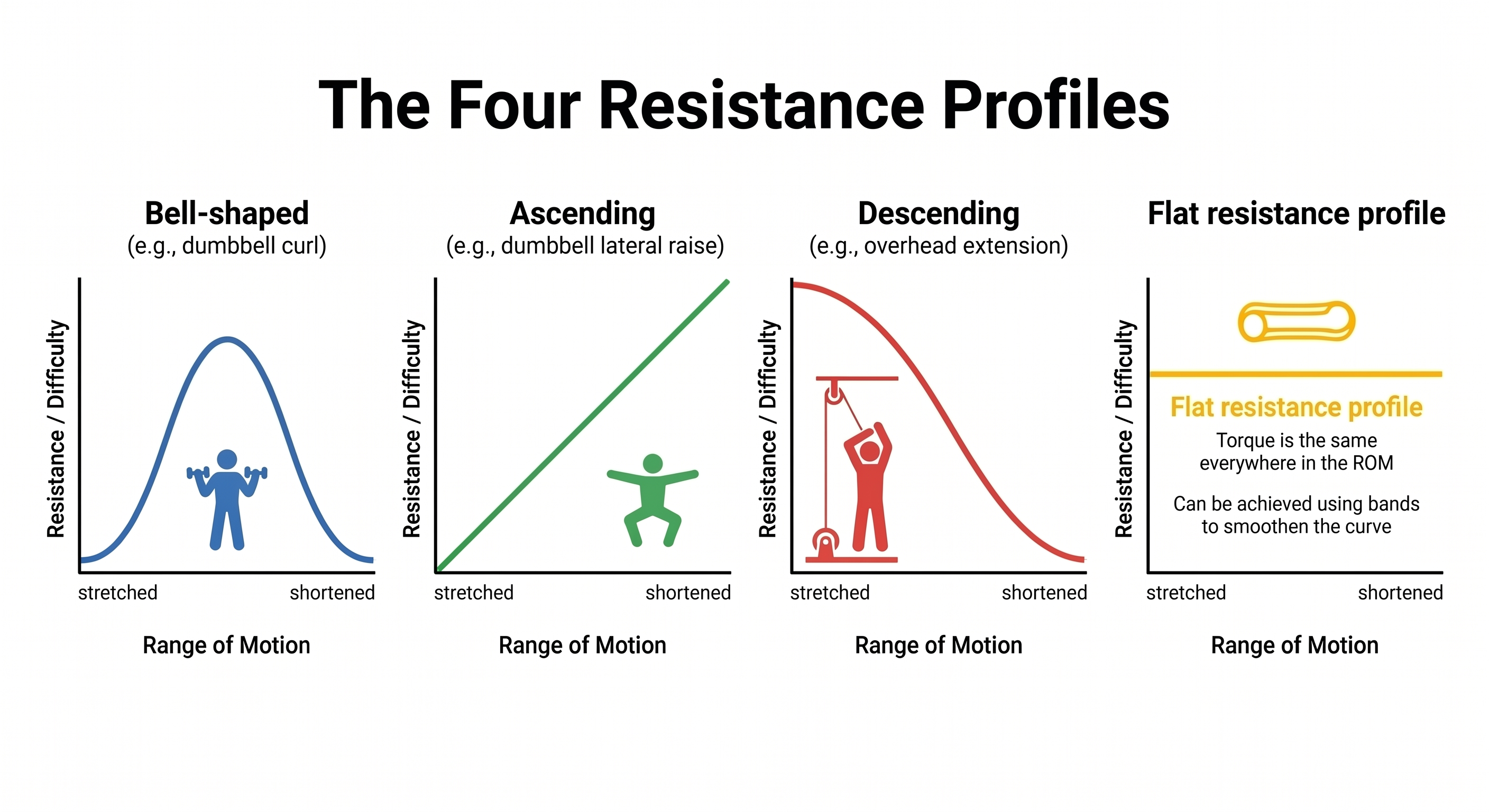
Free weights demand significant stabilization, which limits absolute force output on the target muscle (see 4.2.1) but develops intermuscular coordination and athleticism. For hypertrophy, their main limitation is that the resistance profile is fixed by gravity—you cannot independently tune where the load is highest.