2.1.6: The Non-Negotiable Synergy: Why Both Recruitment and Tension Are Required
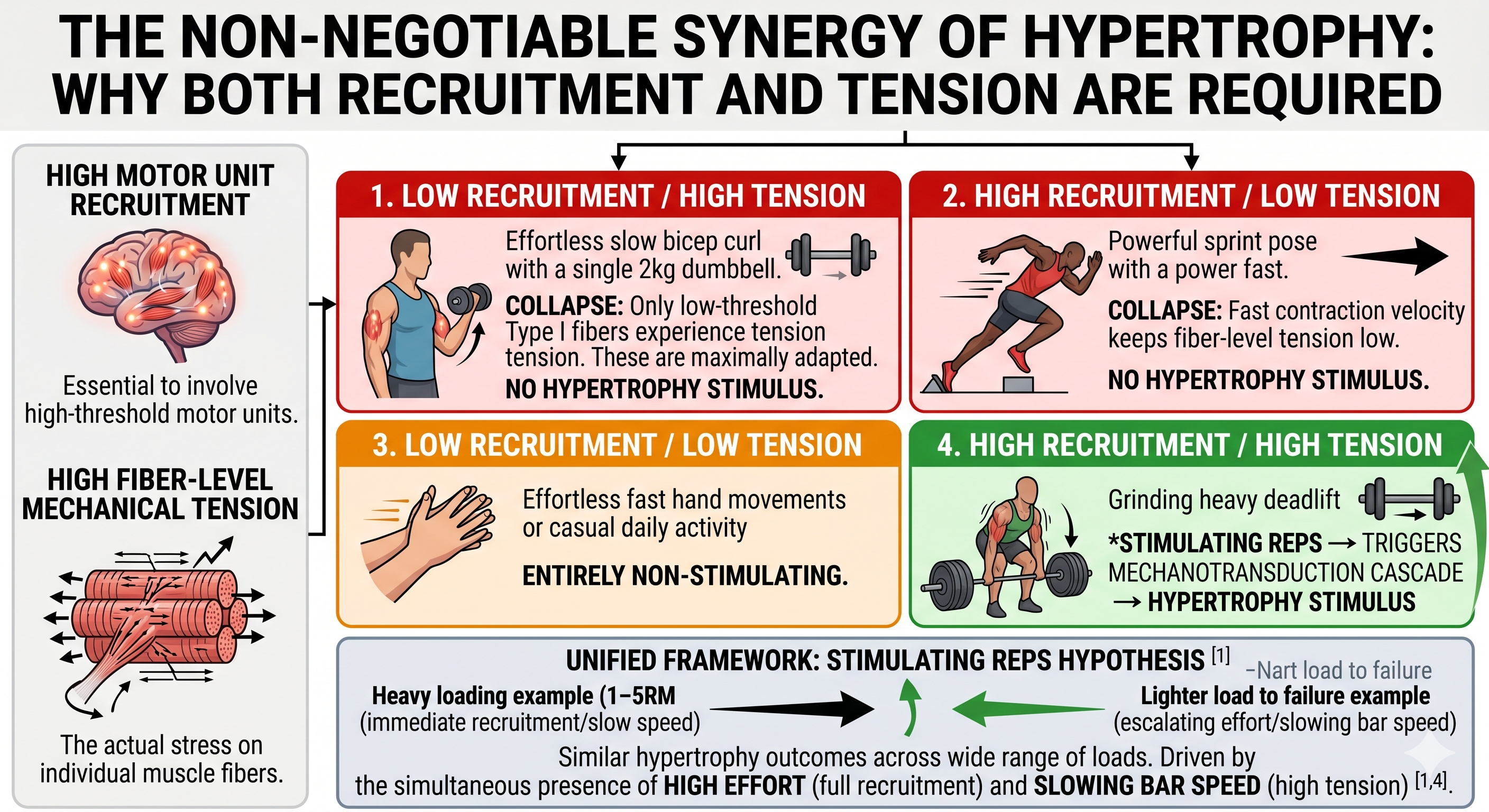
The central argument of this book is that hypertrophy requires the simultaneous presence of:
- High motor unit recruitment
- High fiber-level mechanical tension.
The scientific literature is quite unequivocal on this point: resistance training stimulates muscle growth precisely because of “the key roles motor unit recruitment and mechanical tension play” [1,4].
Consider the four possible scenarios during any given rep:
- Low recruitment, high tension (effortless slow movements with light load): Performing a slow, controlled bicep curl with a 2 kg dumbbell involves low requirement for force, so only low-threshold motor units are recruited. The slow speed means these fibers experience high mechanical tension, but because the fibers in question are already maximally adapted Type I fibers from daily activity, no hypertrophic stimulus occurs.
- High recruitment, low tension (maximal effort at high velocity): Sprinting, jumping, or throwing a light object involves maximal effort and full motor unit recruitment, but the contraction velocity is extremely fast. The force-velocity relationship ensures that fiber-level mechanical tension is low, and thus no hypertrophy occurs.
- Low recruitment, low tension (effortless fast movements): This describes most daily activities and warm-up sets and is entirely non-stimulating.
- High recruitment, high tension (maximal effort at slow velocity): This is the only combination that triggers the mechanotransduction cascade in high-threshold motor units. It occurs during heavy strength training (1–5RM loads, where full recruitment is immediate and bar speed is inherently slow) and during the final, grinding repetitions of a lighter-load set taken to failure, where escalating effort meets slowing bar speed.
| Low Tension (fast contraction) | High Tension (slow contraction) | |
|---|---|---|
| Low Recruitment (low effort) | ❌ Daily activities, warm-ups | ❌ Light slow curls — fibers adapted, no stimulus |
| High Recruitment (high effort) | ❌ Sprints, jumps, throws | ✅ Growth zone: heavy training or final grinding reps to failure |
This model, also known as the stimulating reps hypothesis, elegantly unifies the apparently contradictory evidence: sets taken to failure produce similar hypertrophy across a wide range of loads (from 30% to 85% of 1RM—your one-repetition maximum, the heaviest weight you can lift once) not because “the pump” or metabolic stress are driving growth, but because the final challenging reps of any set to failure inevitably involve both high effort (full recruitment) and slowing bar speed (high tension).
It’s also worth noting that there are cases where high tension can occur without high recruitment, such as static passive stretching or eccentric-only (lowering-phase-only) contractions. However, in this book we take for granted that motor unit recruitment is a prerequisite for hypertrophy, and thus these scenarios are not relevant to our discussion of the core driver.