1.1 The Mechanotransduction Pathway: From Load to Gene Expression
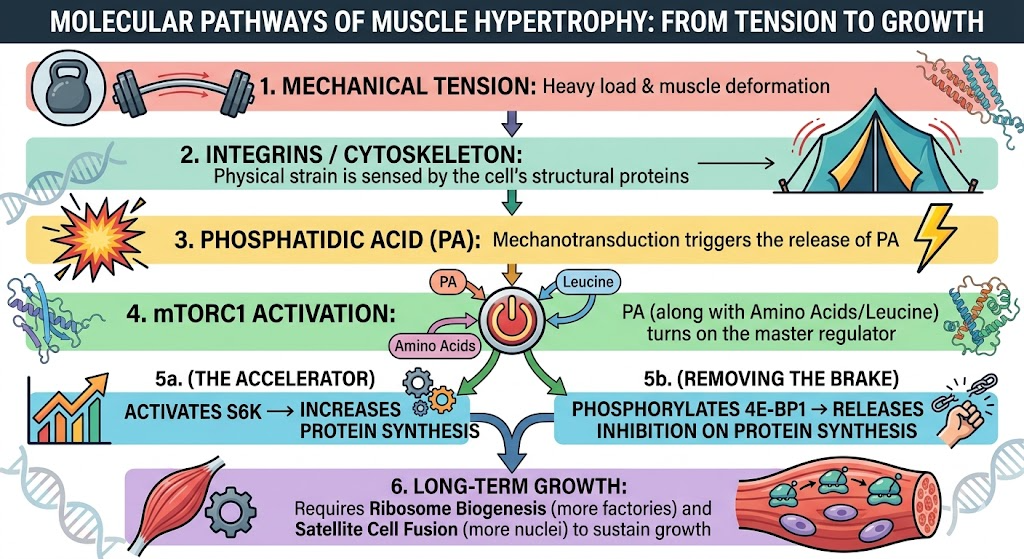
Muscles do not grow because they are holding a weight; they grow because they are deforming under that weight. When you lift something heavy, the physical strain on the muscle fibers—the individual cells that make up your muscles—triggers a cascade of chemical signals, a process called mechanotransduction.
Think of the muscle cell as a tent. The fabric is the cell membrane (sarcolemma), and the poles are the structural proteins inside (the cytoskeleton). When you apply a heavy load, you pull on those poles. The pulling creates tension that is sensed by specific proteins embedded in the cell’s structure.
The primary sensors are integrins—proteins that bridge the outside of the cell to the inside. When the muscle is stretched or placed under high tension, integrins physically deform. This deformation activates an enzyme called Focal Adhesion Kinase (FAK), which sets off a chain reaction inside the cell [1].
Crucially, mechanical tension also triggers the release of Phosphatidic Acid (PA) via the enzyme Phospholipase D (PLD). PA is a lipid molecule that acts as a direct chemical messenger. When the cell senses enough deformation, it produces PA, which then seeks out the master switch of muscle growth: mTORC1 [2].