2.1.4: The Force-Velocity Curve: The Tension Gatekeeper
Recruiting a high-threshold motor unit is necessary, but it is not sufficient. The amount of mechanical tension that a recruited fiber actually experiences is governed by the force-velocity relationship, a fundamental property of muscle contractile physiology [3]. This relationship dictates that the force a muscle fiber can produce during a shortening (concentric) contraction is inversely proportional to its shortening velocity. When a fiber contracts rapidly, the actin and myosin filaments slide past each other so quickly that only a small number of cross-bridges—the temporary links between the contractile proteins actin and myosin that generate force—can form at any given moment, resulting in low force and low mechanical tension. When the same fiber contracts slowly, a large number of cross-bridges engage simultaneously, generating high force and, consequently, high mechanical tension.
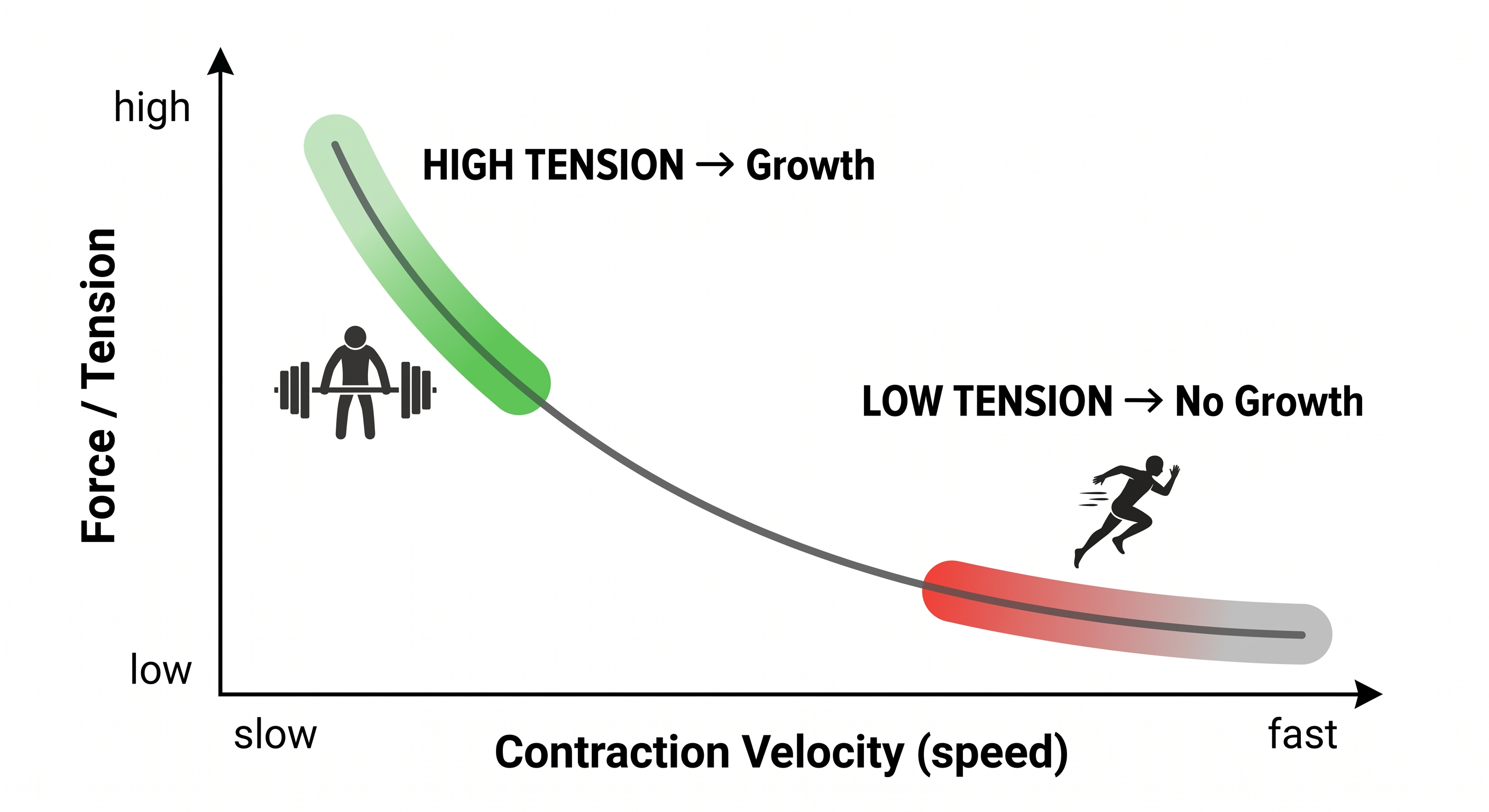
This principle explains why not all reps that recruit high-threshold motor units are equally effective. If you perform a maximal-effort throw or a jump, your nervous system recruits the largest motor units forcefully, but the movement velocity is extremely high. The force-velocity curve dictates that these fibers therefore produce very little force, resulting in minimal mechanical tension and, predictably, no hypertrophy. The force-velocity relationship acts as a gatekeeper: high-threshold motor unit recruitment opens the gate, but slow contraction velocity is what allows the tension to flow through.