2.1.1: What Is a Motor Unit?
Before we can discuss how muscles are stimulated to grow, we need to understand the basic unit of muscle activation: the motor unit.
A motor unit is composed of two things:
- A motor neuron — a nerve cell in the spinal cord that sends electrical signals to the muscle.
- The group of muscle fibers (individual muscle cells) that this single motor neuron controls.
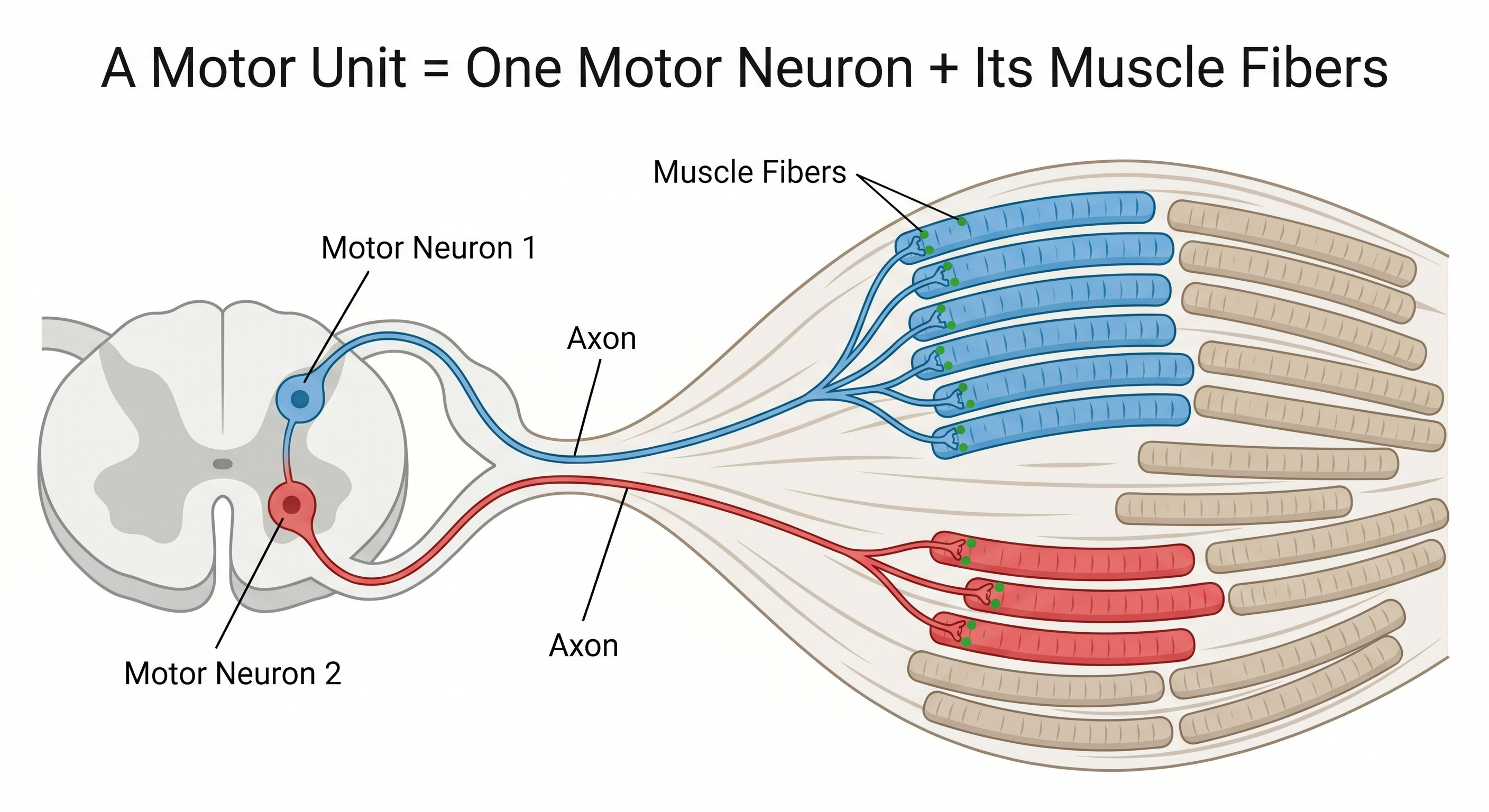
When the motor neuron fires, every fiber it controls contracts simultaneously — it’s an all-or-nothing system. A single muscle can contain hundreds of motor units, each controlling a different group of fibers. When your brain decides to move a muscle, it doesn’t activate every motor unit at once. Instead, it selectively recruits motor units depending on how much force is needed for the task. This process is called motor unit recruitment (MUR) — a concept that will form the backbone of everything in this chapter.
Think of it like a factory with many light switches. Each switch controls a different set of machines. For a simple task, the foreman only flips a few switches. For a demanding task, more and more switches are turned on until the entire factory is running at full capacity.
The key takeaway: you cannot grow a muscle fiber that was never activated. If a motor unit is never recruited during an exercise, the fibers it controls receive no growth stimulus whatsoever — no matter how heavy the weight on the bar.