4.2.4: Matches the Joint Actions & Respects Active Insufficiency
Every exercise imposes a line of pull and a trajectory that must align with the target muscle’s anatomical line of action. A biceps curl where the cable pulls perpendicular to the forearm at 90° of elbow flexion maximizes the moment arm (the perpendicular distance between the line of resistance and the joint, which determines how much torque the muscle must produce) of the biceps; a curl where the line of pull is nearly parallel to the forearm does almost nothing. This is the principle of matching the exercise to the joint action the muscle actually performs. The joint actions table in Section 4.1 defines the primary functions of every major muscle; use it as your reference.
The practical checklist:
- Define the muscle’s primary function(s). Refer to 4.1. Pectoralis major: horizontal adduction, shoulder flexion. Latissimus: shoulder extension, adduction. Biceps: elbow flexion, supination.
- Ensure the exercise allows full ROM through those actions. If a machine locks the movement into a path that limits the muscle’s natural arc, tension drops off where it should be highest.
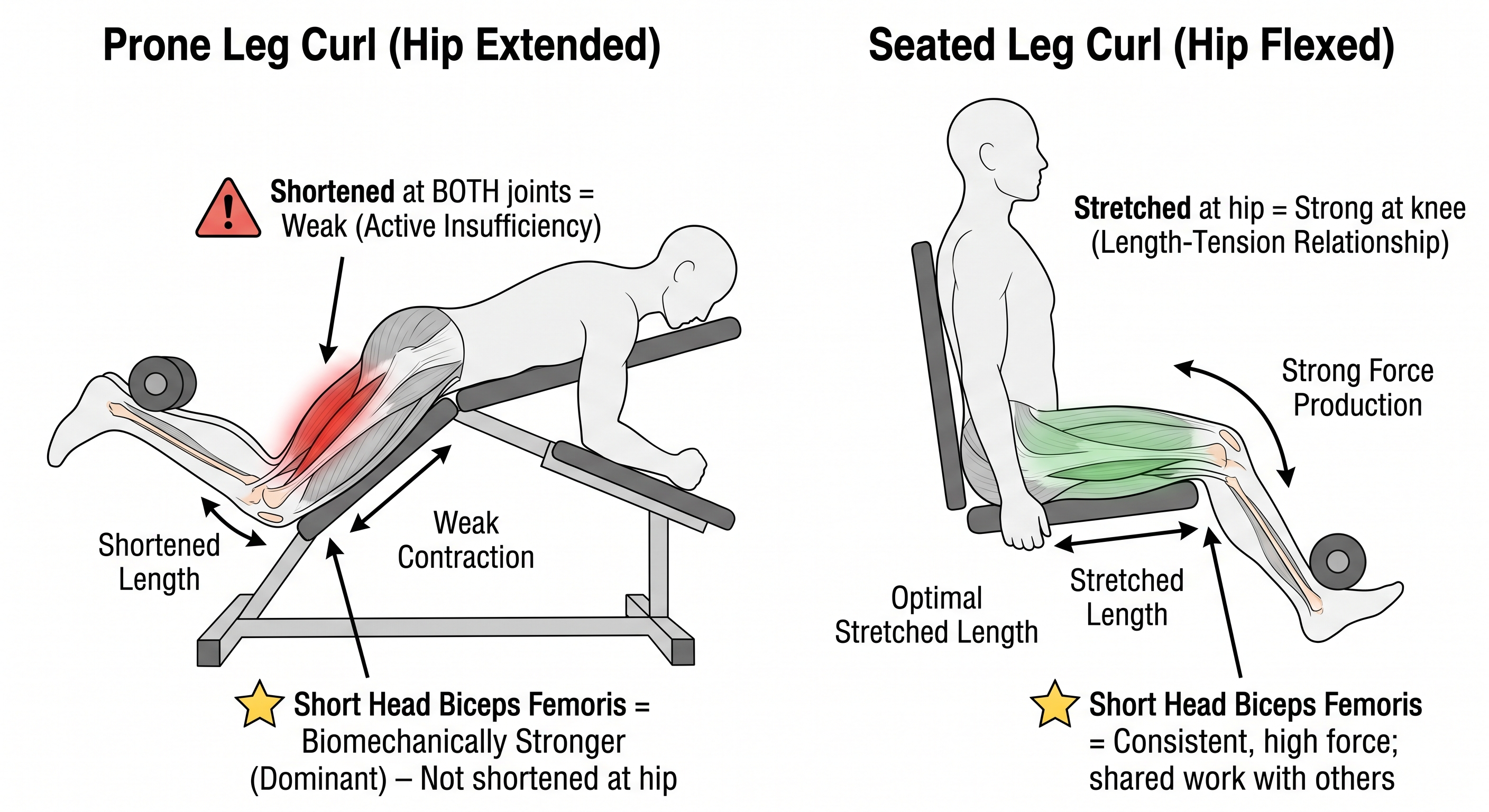
- Consider multi- vs. single-joint functions. A two-joint muscle (e.g., hamstrings, rectus femoris, biceps, triceps long head) changes length with two joint angles. Exercises that train it at long lengths across both joints (e.g., seated leg curl with hip flexed for hamstrings) provide a superior stimulus because they avoid the force-sapping effect of active insufficiency.
Active insufficiency occurs when a multi-joint muscle is shortened at both joints simultaneously and can no longer produce meaningful force. For example, the hamstrings cannot flex the knee forcefully if the hip is extended (prone leg curl), because the muscle is already shortened at the hip. The same hamstring can produce far more tension when the hip is flexed (seated leg curl) because the muscle is stretched across the hip, putting it in a longer, stronger position at the knee. Choosing exercises that avoid excessive active insufficiency of the target muscle ensures that high tension can be generated throughout the range of motion. Conversely, you can deliberately use active insufficiency to isolate a particular head: the long head of the triceps is placed on slack during a pushdown with elbows in front of the body, reducing its contribution and biasing the lateral and medial heads.
Matching joint actions and managing active insufficiency also protects against injury. When an exercise forces a muscle to produce force in a mechanically disadvantaged alignment, stress shifts to passive structures (tendons, ligaments, joint capsules). The exercise might still produce some muscle hypertrophy, but it accumulates joint irritation that, over time, can derail a training block.