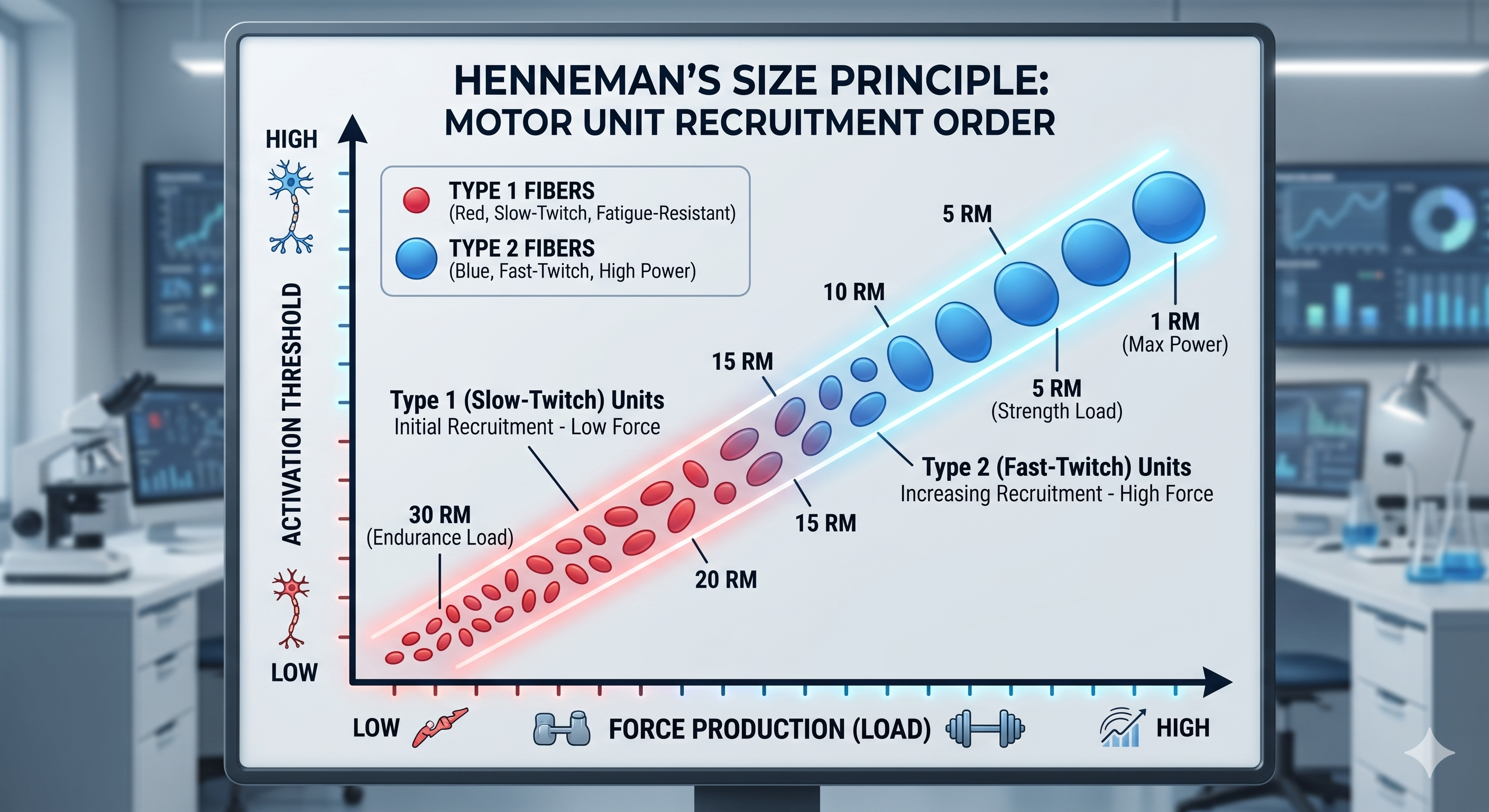
2.1.3: Henneman’s Size Principle: The Non-Negotiable Law of Recruitment
The nervous system does not activate muscle fibers randomly. It follows a strict hierarchical order known as Henneman’s Size Principle, which states that motor units are recruited in ascending order of size, from smallest to largest, depending on the force demands of the task [2]. Small, low-threshold motor units, which control fatigue-resistant but small-diameter slow-twitch (Type I) fibers, are activated first during low-force activities. As the central nervous system perceives a need for greater force output, it progressively recruits larger, high-threshold motor units. These large motor units control the fast-twitch (Type II) fibers, which possess the greatest capacity for force production and, critically, for hypertrophy.
The practical implication of the Size Principle is clear: to stimulate a Type II fiber to grow, you must first recruit it. If a set of an exercise is terminated before the nervous system is forced to call upon its largest motor units, the Type II fibers remain dormant, contributing nothing to the movement and receiving no growth stimulus whatsoever. This is why walking, despite involving thousands of muscular contractions, does not produce leg hypertrophy—the force requirement is so low that only low-threshold motor units are ever activated, and their associated Type I fibers are already adapted to daily life and are at their maximum functional size.