4.3.2: The Two-Exercise Rule: Cover the Full Contractile Range
If two (or more) exercises can be allocated to a single muscle, the goal expands: select one exercise that emphasizes the lengthened position and a second that emphasizes the shortened position, so that together they expose the entire muscle—and its different regions—to high tension across the full contractile range. This is a direct application of the regional hypertrophy and neuromechanical matching principles discussed in Chapter 3.
Because individual muscles vary in architecture, the specific exercises will differ by muscle group, but the pattern is:
-
Exercise 1 (Lengthened emphasis): The load is high when the muscle is stretched. For most muscles this means a descending or bell-shaped resistance profile with peak tension at long muscle lengths. The stretch is maximized by positioning the relevant joints so the muscle is elongated (e.g., hip flexion for hamstrings, shoulder extension for biceps long head, knee flexion for rectus femoris).
-
Exercise 2 (Shortened emphasis): The load is high when the muscle is contracted. This often means an ascending resistance profile—the weight gets harder as the joint extends or the muscle shortens—or an isolation movement that can be biased toward the contracted position and avoids excessive passive insufficiency of the target fibers (e.g., a leg extension for the quadriceps at short length, a preacher curl for biceps, a lateral raise with a peak contraction at the top).
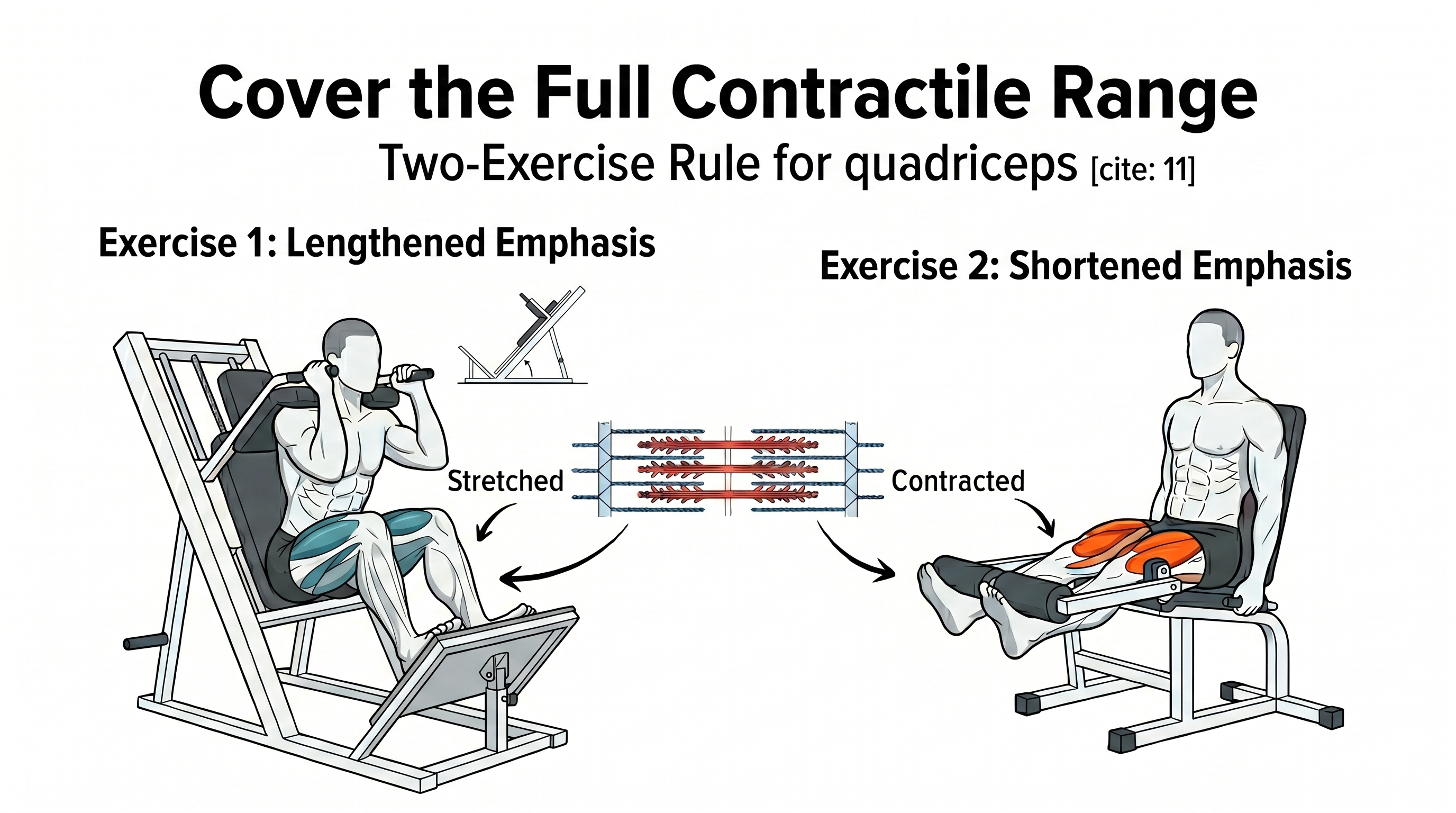
This two-exercise strategy does not double volume; it splits the existing volume across two movements. The total number of working sets per muscle remains governed by the volume guidelines in Chapter 5. What changes is that the stimulus is more complete—proximal and distal fibers, sarcomeres at short and long lengths, all receive their share of high mechanical tension.
If a third or fourth exercise can be justified—typically only for advanced lifters with high volume tolerance and specific weak points—additional movements can target mid-range emphasis, unilateral imbalances, or secondary functions (e.g., a row that emphasizes scapular retraction in addition to lat extension).
As with the one-exercise rule, the two-exercise rule is a guideline, not an absolute mandate. If you have specific reasons to deviate (e.g., injury, equipment constraints, personal preference), that’s fine. However, take into account that training in the lengthened range causes more muscle damage, therefore, do not overdo it. Shortened position exercises are generally less damaging and can be used more frequently, while lengthened position exercises should be programmed with appropriate recovery in mind.